
Reviewed against Pakakumi's current terms and responsible gambling policy. Last updated Jul 21,. Reviewed by Jack Owens, Managing Editor.
The Core Decision: When to Cash Out
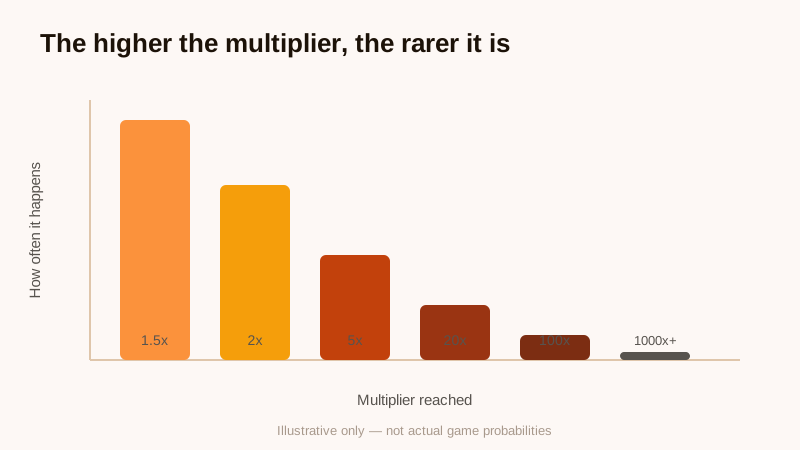
Every round of Aviator on Pakakumi presents one critical decision: cash out now, or hold for a higher multiplier? There is no universally correct answer — only trade-offs between hit rate and payout size. This guide breaks down three risk profiles so you can choose a style that matches your bankroll and temperament.
Low-Risk Profile: 1.5x–2.0x Target
- Hit rate: ~65–75% of rounds reach 2x before crashing.
- Payout per win: 1.5–2x your stake.
- Bankroll need: Low — can sustain long sessions with small stakes.
- Best for: New players, strict session budgets, auto cash-out users.
Set auto cash-out to 1.8x or 2.0x and let the system execute. You'll win most rounds, but individual payouts are modest. See our auto cash-out guide for setup steps.
Medium-Risk Profile: 2.5x–5x Target
- Hit rate: ~30–45% of rounds reach 3x; ~20% reach 5x.
- Payout per win: 2.5–5x your stake.
- Bankroll need: Medium — need buffer for 5–10 consecutive misses.
- Best for: Players comfortable with variance, manual or auto cash-out.
High-Risk Profile: 5x+ Target
- Hit rate: ~10–15% for 10x; under 5% for 20x+.
- Payout per win: 5–50x+ your stake.
- Bankroll need: High — expect long cold streaks.
- Best for: Experienced players with strict stop-loss discipline.
Key Discipline Rules (All Profiles)
- Decide your target before the round starts — never while the multiplier is climbing.
- Set a session budget and stop-loss; walk away when hit.
- Use auto cash-out for low/medium targets to remove reaction-time errors.
- Never chase a missed target by increasing stake on the next round.
Our Complete Guide to Playing Aviator in Kenya covers registration and your first bet. The responsible gambling guide has the full toolkit for limits and support.
Common Cash-Out Mistakes to Avoid
Even players who understand the risk profiles still fall into predictable traps. The most common ones:
- Chasing a lost round with a bigger stake. A crash doesn't mean the next round is "due" to go higher — each round is independent. Doubling up after a loss is one of the fastest ways to blow through a session budget.
- Cashing out late because "it's been low all session." Past rounds don't influence future ones. The multiplier curve doesn't "owe" you a high round just because the last few were short.
- Switching targets mid-round. The whole point of picking a profile is consistency. Changing your target at 3.00x because it "might go higher" is exactly how low-risk sessions turn into high-risk losses.
- Ignoring auto cash-out. Manual cash-out works if you have perfect discipline, which most players don't once adrenaline kicks in. Auto cash-out removes the temptation entirely.
Frequently Asked Questions
What's the difference between low-risk and high-risk cash-out approaches in Aviator?
Low-risk means cashing out early and often, at smaller multipliers, for smaller but more frequent wins. High-risk means holding out for bigger multipliers, which pay more when they land but crash out more often before you get there.
Does cashing out early guarantee I'll come out ahead?
No. Frequent small wins feel safer, but the house edge applies to every round regardless of your target multiplier. Cashing out early more often does not change the underlying odds of any individual round.
Which risk profile should a beginner use?
There's no universally correct answer, but starting with a lower-risk target while you learn how quickly the multiplier moves is generally easier to manage than chasing high multipliers from round one.
Can auto cash-out help with a chosen risk profile?
Yes. Setting an auto cash-out target that matches your chosen risk profile removes the temptation to deviate from it mid-round, when a climbing multiplier makes "just a bit longer" feel tempting.
Related reading