
Reviewed against Pakakumi's current terms and responsible gambling policy. Last updated Jul 30,. Reviewed by Jack Owens, Managing Editor.
Aviator has become one of Kenya's most-played crash games on leading online gambling sites. On Pakakumi, Kenya's best online casino for multiplier games, Aviator sits alongside the platform's original Crash game, not in place of it. Play Aviator, Crash Games, and Football Sports Betting all on one platform. The mechanic itself is simple: bet, watch the multiplier rise, and cash out before it crashes. Multipliers can reach up to 3,000x on Aviator, which means even a small stake can return a significant payout if you time your cash-out well. What takes longer to get right is cash-out timing, what RTP actually measures, and how to deposit without friction on an online casino. This guide covers all three, plus registration and bankroll basics, so you're ready to play Aviator online in Kenya with confidence.
1. What Is Aviator?
Aviator is a provably-fair multiplier game. Each round, a plane takes off and a multiplier climbs from 1.00x upward, increasing for as long as the plane stays in the air. At some unpredictable point, the plane "flies away" and the round ends. Players place a stake before the round starts. The only decision that matters is when (or whether) to cash out before that happens. Cash out in time and you win your stake multiplied by whatever the multiplier showed at that instant. Wait too long, and the stake is lost.
Unlike slot machines or table games, there are no symbols, cards, or reels to learn. The entire game is one repeating decision: hold, or cash out. That simplicity is a large part of why it spread so quickly among mobile-first players in Kenya, where a round takes seconds and can be played one-handed between other tasks.
2. How Aviator Works
Every round follows the same sequence:
- A short betting window opens before the plane takes off, during which you place your stake.
- Once the round starts, the multiplier begins climbing from 1.00x, rising visually alongside the plane's flight path.
- At any point while the plane is still flying, you can tap Cash Out to lock in your stake × the current multiplier.
- The round ends the instant the plane "flies away." Anyone still holding an uncashed bet at that moment loses the stake for that round.
The crash point (the multiplier at which the plane flies away) is generated independently for every round by the game's engine. Previous rounds, your stake size, and how long you've been playing have no bearing on it.
3. Registering and Depositing with M-Pesa
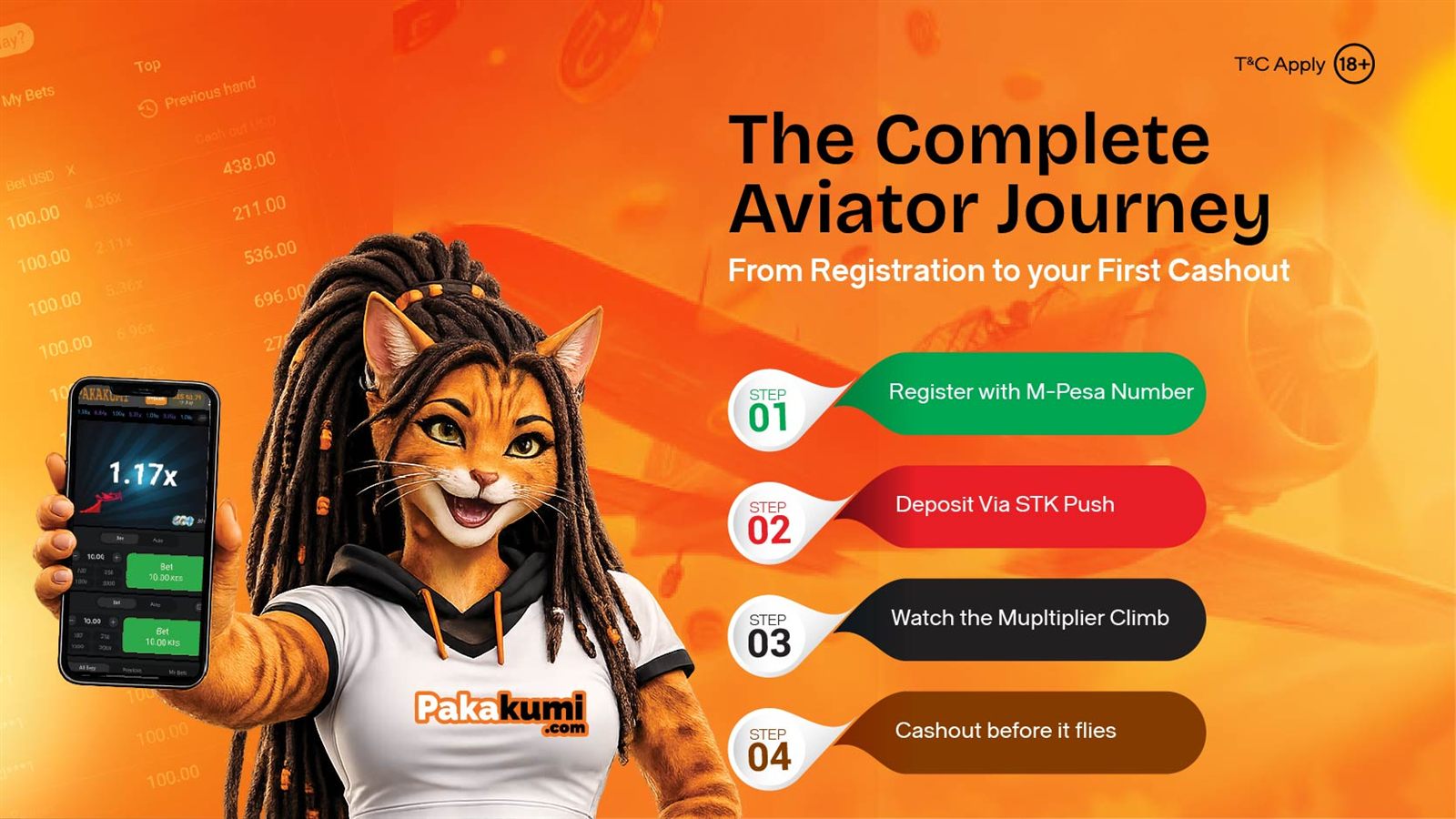
Getting set up takes a few minutes. Pakakumi's platform streamlines this into three steps:
- Register: visit pakakumi.com/register and sign up with your Safaricom M-Pesa number, which doubles as your login and your deposit/withdrawal channel.
- Deposit: choose an amount and confirm the M-Pesa STK Push prompt sent to your phone. Funds typically reflect in your account within moments.
- Play: head to Aviator and place your first stake.
Withdrawals follow the same channel in reverse, paying out to the M-Pesa number tied to your account. If a deposit doesn't reflect immediately, check for a pending M-Pesa confirmation on your phone before retrying — our M-Pesa troubleshooting checklist covers this in full.
Common registration hiccups, and how to clear them:
- "Number already registered." Each M-Pesa number can only be tied to one Pakakumi account. If you've previously signed up and forgotten, use the login screen's account recovery option instead of registering again.
- OTP or confirmation SMS not arriving. Usually a signal issue rather than an account problem — check for airtime/network restrictions on the SIM, then request the code again rather than repeatedly resubmitting the form.
- Registering with a number you don't actively use. Since withdrawals only ever pay out to the number used to register, losing access to that SIM later locks you out of your own payout channel. Use a line you control long-term.
- Weak or rejected password. Follow the on-screen password requirements exactly; a common cause of a stuck sign-up form is a password that silently fails validation without a clear error.
If none of these resolve it, contact Pakakumi support directly through pakakumi.com or the 24/7 helpline rather than repeatedly resubmitting the registration form.
4. Placing Your First Bet
Pakakumi also offers a free demo mode, letting you play Aviator with virtual credit before staking any real money — a useful way to get a feel for how fast the multiplier moves and how the cash-out button responds, with no financial risk. Switch to real-money play whenever you're ready.
Beyond the demo, new players are generally better off starting with the minimum real-money stake for the first several rounds rather than jumping straight to bigger bets — see our minimum deposit and stake guide for current figures. A few practical habits worth adopting from round one:
- Decide your cash-out target before the round starts, not while the multiplier is climbing and adrenaline is up.
- Treat the first few rounds as orientation, not a strategy test.
- Keep track of your total stake for the session, not just individual round outcomes.
5. Manual vs. Auto Cash-Out
Pakakumi's Aviator supports two ways to cash out:
- Manual cash-out means you tap Cash Out yourself, at whatever moment you decide. It gives full control, but the outcome depends on your own reaction time and judgement.
- Auto cash-out lets you set a target multiplier in advance (say, 2.00x); the system cashes out the instant that multiplier is reached, taking reaction time out of the equation.
Auto cash-out is useful for players who want consistency round to round, since it removes the temptation to "just wait a bit longer" once the multiplier is already climbing. See our cash-out strategy guide for how low, medium, and high-risk targets compare.
6. Is Aviator Random?
Yes. Aviator uses a random, provably-fair round generator, meaning the crash point for each round is determined independently and can't be reliably predicted from past rounds, betting patterns, or time of day. Be wary of any third-party app, browser extension, or "Aviator predictor" claiming to forecast crash points in advance. These tools cannot see or influence the underlying random generation. Paid "signal" services built around that claim are not affiliated with Pakakumi.
7. What RTP Actually Means
RTP (Return to Player) describes the theoretical percentage of all money wagered on a game that gets paid back to players, calculated over a very large number of rounds, typically millions — a long-run statistical average, not a promise about your next session. Our odds and probability guide covers the maths in full; the short version is that a published RTP figure only becomes meaningful at a scale no individual player reaches, so use it to understand the house edge, not to predict a short-term outcome.
8. Bankroll Management
The single most useful habit for any crash-game player: decide, before you start, exactly how much you're willing to stake in a session. Stop when you hit that number, regardless of whether you're up or down. A few starting principles:
- Set a session budget you can afford to lose entirely. Don't top it up mid-session.
- Split that budget across multiple smaller stakes instead of a few large ones, so you get more rounds and more decision points.
- Decide your stop-loss and your "walk away on a win" point in advance, then hold to both.
9. Common Beginner Mistakes
Most early losses come from a small set of avoidable habits:
- Chasing losses. Increasing your stake to "win back" a previous round only compounds the risk instead of resolving it.
- Waiting too long to cash out, getting drawn in by a climbing multiplier well past your original target.
- No pre-set budget: playing without a defined stop point makes it easy to lose track of total spend across a session.
- Playing on autopilot. Bets placed from habit instead of attention are especially common during long sessions.
10. Playing Responsibly
Aviator, like all crash games, is entertainment, not a way to cover a financial shortfall. Pakakumi builds responsible-gaming tools directly into the account dashboard. Setting limits, recognising risky play, and knowing where to get support are covered in full in our complete guide to responsible gambling on Pakakumi. If you're setting up your account for the first time, configure your limits now, while you're calm and thinking clearly; waiting until after a rough session makes it a much harder call to get right.
- Set a deposit limit to cap how much you can add to your account in a given period.
- Self-exclude if you need to step away completely for a set period.
- The 24/7 helpline (0743 999 333) is there if you or someone you know needs to talk to someone.
11. Frequently Asked Questions
Is Aviator legal to play in Kenya?
Yes. Pakakumi is licensed and regulated by the Betting Control and Licensing Board of Kenya (BCLB) under Licence Numbers BK 0001230 and PG 0001229, operated by Reys and Meys Limited. Players must be 18 or older.
Is Aviator random, or can it be predicted?
Yes, fully random per round (see section 6 above). If you've seen "predictor" apps advertised, our breakdown of why they don't work covers the mechanics in detail.
What is RTP in Aviator?
Covered in section 7 above. In short: a long-run average, not a per-session guarantee.
How much do I need to start playing Aviator on Pakakumi?
Pakakumi's minimum deposit and stake are both low enough to start small. Our minimum deposit and stake guide has the current figures.
Can I try Aviator for free before betting real money?
Yes. Pakakumi offers a free demo mode using virtual credit, so you can get familiar with how Aviator works before switching to real-money play.
How do I deposit and withdraw using M-Pesa?
Section 3 above covers the basics. For troubleshooting a delayed deposit or a failed withdrawal, see our M-Pesa payments guide.
What's the difference between manual and auto cash-out?
Section 5 above walks through both. Auto cash-out is generally the steadier choice if reaction time under pressure isn't your strength.
Is there a strategy that guarantees winning at Aviator?
No. Aviator carries a built-in house edge; no staking pattern or cash-out rule changes the odds of any individual round. Strategies can manage risk and pace your play, but none of them turn the game profitable over time.
What should I do if I feel like I'm losing control of my play?
Use the deposit-limit or self-exclusion tools in section 10 above right away. Consider taking a break too. The 24/7 helpline is there, whether or not you decide to keep playing.
Aviator is straightforward to pick up. The players who stick with it longest tend to be the ones who treat the multiplier as entertainment with a built-in house edge, not a system to be solved. Set your limits, take your time in the first few rounds, and use the tools above if play ever stops feeling like fun.
Related reading